


Research
Research News
Research News
Total 83
-
Dongguk University receives record-high number of R&D projects c...
Dongguk University receives record-high number of R&D projects commissioned in 1H 2021Up 23% from last year to 67.3 bil. won, of which new orders account for 40.6 bil. wonDongguk University’s efforts to strengthen its R&D competitiveness are bearing fruit. On August 21, the Office of Research announced that the value of R&D project orders received in the first half of 2021 reached a record high of 67.3 billion won, up 23% from the same period last year, including new orders of 406 billion won.By sector, projects included 10.32 billion won for Buddhism and culture, 10.97 billion won for biotech and medicine, 13.29 billion won for DNA, and 6.06 billion for safety and security.In Buddhism and culture, Prof. Kim Jong-uk, College of Buddhist Studies, and Prof. Jeong Ju-won, Department of Home Economics Education, were the largest funding recipients. Prof. Kim Dong-eok, College of Medicine, and Prof. Kwon Gyong-hee, College of Pharmacy, topped the list in biotech and medicine. In DNA, Prof. Kim Heung-su, Department of Mechanical, Robotics, and Energy Engineering, and Prof. Lim Hyeon-sik, Division of Physics-Semiconductor Science, won the most significant share of contracts. In safety and security, Prof. Park Jin-ho, Department of Multimedia Engineering, and Prof. Jo Eun-gyeong, College of Police and Criminal Justice made a significant contribution.Kim Gwan-gyu, Vice-President of Research, said, “The Office of Research is responsible for managing R&D projects in four specialized categories. These efforts have led to record-high results. Drawing on a combination of our superior research capabilities and excellent research staff, we remain dedicated to achieving best results in R&D projects in the second half of this year as well.”
2021.09.02. 5172 -
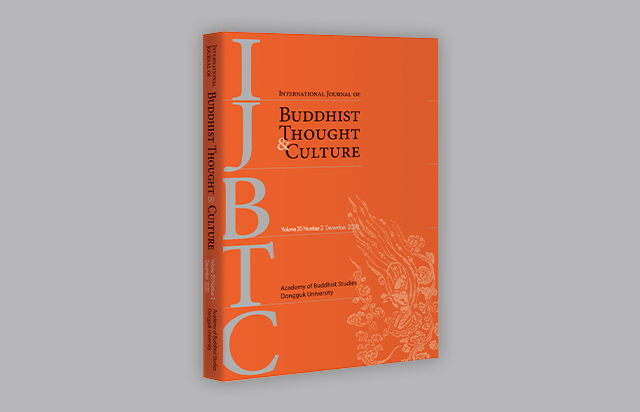
The Academy of Buddhist Studies at Dongguk University published ...
The Academy of Buddhist Studies at Dongguk University published Volume 30, No. 2, of the International Journal of Buddhist Thought & Culture (IJTBC), an international journal of Buddhist studies It comprises theses and reviews of renowned scholars from around the world, including the United States, France, the United Kingdom, and Japan The Academy of Buddhist Studies at Dongguk University (Ven. Jagwang, Head of Academy) published Volume 30, No. 2, of the International Journal of Buddhist Thought & Culture (IJTBC).The IJBTC (co-editors: Kim Jong-wook of Dongguk University and Richard McBride of Brigham Young University) is the only English-language Buddhist journal in Korea, with eight foreign scholars from India, the United States, Thailand, Taiwan, Canada, Norway, Denmark, and Mongolia participating as members of the editorial board.The IJBTC, Korea's first international journal specializing in Buddhism, was selected as a registered journal under the National Research Foundation of Korea (KCI) in 2010 and has maintained its status until now. It has been considered to have set the stage for the internationalization of Korean Buddhism and academic research in Korea. In 2018, it was registered in the citation indexes of the new Thomson Reuters database, “Emerging Sources City Index (ESCI),” and the Atlas Religion Database (Atla DB) of the American Theological Library Association.Vol. 30, No. 2, of the IJTBC, recognized as a major academic journal both domestically (KCI) and internationally (ESCI, Atla), published five special papers, two research papers, and two reviews. The authors are leading and emerging researchers who are internationally diverse and possess academic expertise from Emory University and Alabama State University in the United States; The French School of the Far East; Cambridge University and the British Museum in the United Kingdom; Toyo University of Japan; and Ewha Womans University, Chonnam National University, and Seoul National University in Korea, which have prestigious departments of history, philosophy, and Buddhist studies within their respective countries. The special theme of Vol. 30, No. 2, of the IJTBC is “Dhāraṇī and Mantra in Ritual, Art, and Text,” for which five papers have been published. For this special edition, Professor Paul Copp of the University of Chicago in the United States, who is recognized as a world-renowned scholar in East Asian language and civilization, and Professor Kim Yeon-mi of the Department of Art History at Ewha Womans University, who has been focusing on East Asian Buddhist art, participated as guest editors.Papers on various topics, in which leading researchers such as Ellen Gough of Emory University in the United States, Olivier de Bernon of The French School of the Far East, and Gergely Hidas of the British Museum participated, have been published. These are expected to contribute to a philosophical and historical consideration of Dhāraṇī, which was considered only as a religious and cultural asset.In addition to the special papers, research papers also included papers such as “An Account of Generous Action and Esteem in Pāli Buddhism” by Professor Nicholas Jones at Alabama State University in the United States and two in-depth reviews on the latest research results. The two reviews, which discuss recently published and remarkable Buddhist journals from a serious and open perspective, will also play a major role in navigating the current status of Buddhist studies.This will be an opportunity to expand the horizons of Buddhism and actively discuss directions for future research and international academic exchanges through the latest research achievements of world-class scholars representing each field and papers based on the same. The entire journal is available on the Academy of Buddhist Studies website.
2021.02.15. 9716 -
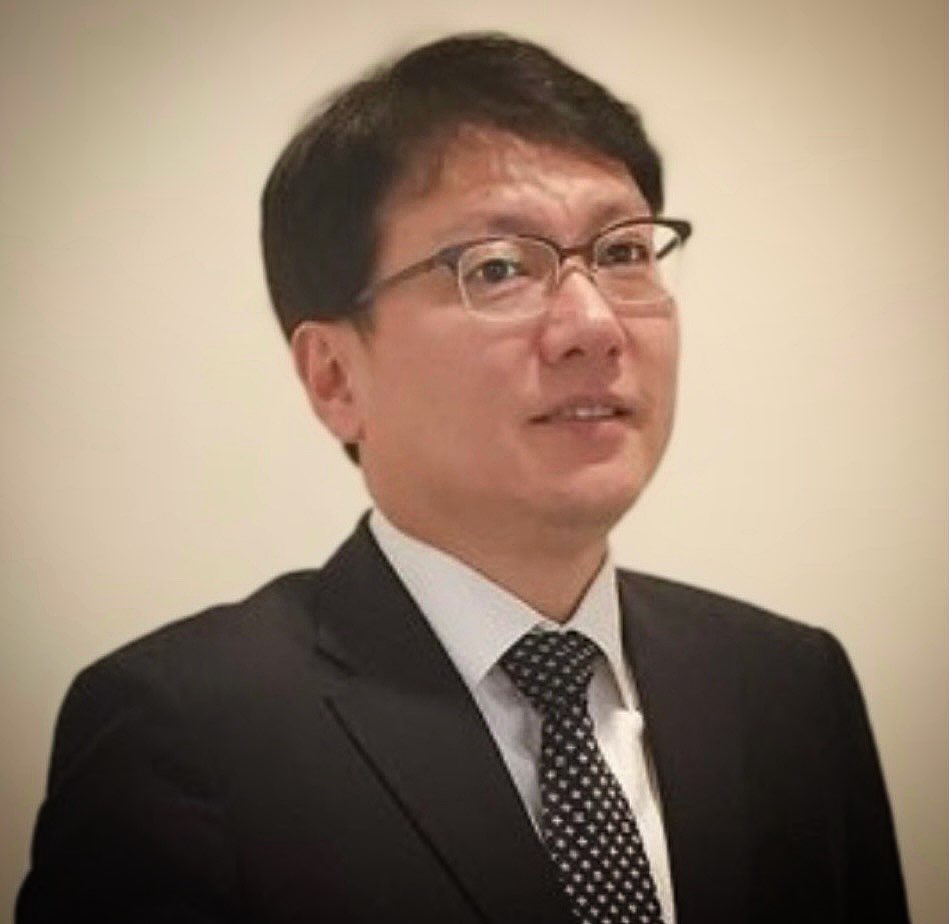
Prof. Jung-Suk Sung from the Department of Life Sciences receive...
Prof. Jung-Suk Sung from the Department of Life Sciences receives Commendation from the Minister of EnvironmentSince 2016, Prof. Sung has undertaken a project analyzing the anti-bacterial, anti-cancer, anti-inflammatory, and cell neurotoxic properties of biotoxin-specific peptides. The project entitled, “Exploring the Usefulness of Natural Organism-derived Toxins” was commissioned by the National Institute of Biological Resources under the Ministry of Environment. He has also developed AI prediction and discovery models for building domestic biological and genetic resources that can be used for the commercialization of useful materials.As a result, three patents were registered and several international papers published He received a commendation in recognition of his contribution towards securing domestic natural organisms and genetic resources through public relations efforts he made in 2018.
2021.01.08. 4761 -
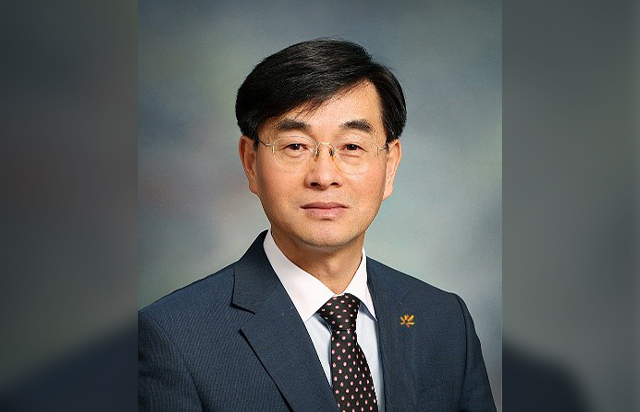
Prof. Young-Dae Gong from the Department of Chemistry receives C...
Prof. Young-Dae Gong from the Department of Chemistry receives Commendation from the Minister of Trade, Industry and Energy Prof. Young-Dae Gong from the Department of Chemistry at Dongguk University received a commendation from the Minister of Trade, Industry and Energy at the Industrial Innovation Platform (I-Platform) vision declaration ceremony held at the Korea Institute for the Advancement of Technology on December 17.Since 2010, Prof. Gong has worked on establishing the Center for Innovative Drug Library Research at Dongguk University as part of the “Industry-Academia-Research Consortium” (project budget: KRW 5 billion) sponsored by the Ministry of Trade, Industry and Energy.He was instrumental in building an innovation platform for equipment and developing a library for unique small drug-based organic molecules. Through this effort, 120 papers were published in internationally renowned journals, 85 patents were registered, and licensing deals were signed in 2019 to transfer commercial technologies.In particular, he received the commendation for his contribution towards enhancing the global competitiveness of Korea's drug industry by developing innovative new drugs and for providing biotech startups and pharmaceutical companies with the knowledge and infrastructure support of the drug library and innovative equipment at the research center.
2021.01.08. 7326 -
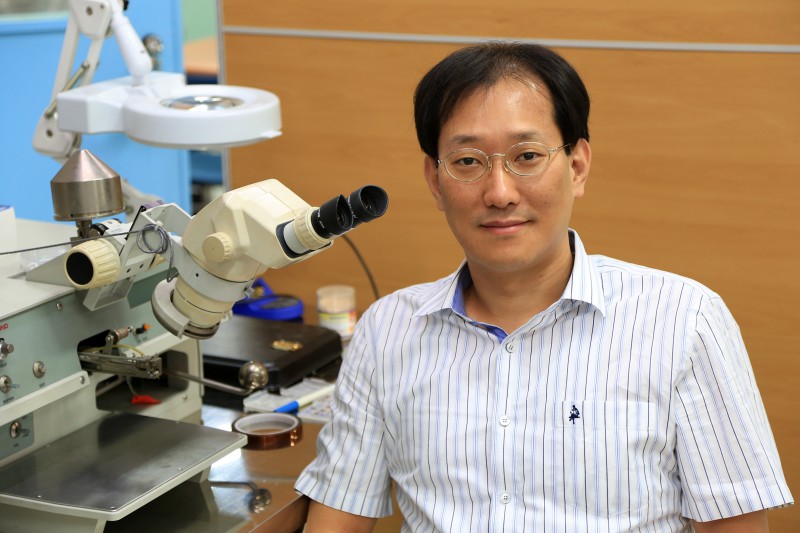
Prof. Hyun-Sik Im from the Division of Physics and Semiconductor...
Prof. Hyun-Sik Im from the Division of Physics and Semiconductor Science receives Commendation from the Minister of Science and Technology Professor Hyun-Sik Im from the Division of Physics and Semiconductor Science at Dongguk University received a commendation from the Minister of Science and Technology at the “2020 Annual Conference on Radiation Technology and Industry Promotion” on December 22. Since 2015, Prof. Im has developed radiation sensors as part of a project to develop source technology for radiation sensors supported by the Research Foundation and the Korean Association for Radiation Application. He has published articles in internationally prestigious academic journals and applied for patents in Korea and elsewhere. He is also undertaking joint research projects with a number of domestic companies.In particular, the commendation was given in recognition of his contribution to enhancing national competitiveness by developing source technology for radiation detection materials.
2021.01.08. 5904 -
Prof. Oh Tae-seok, selected as 50 Excellent Performance for Acad...
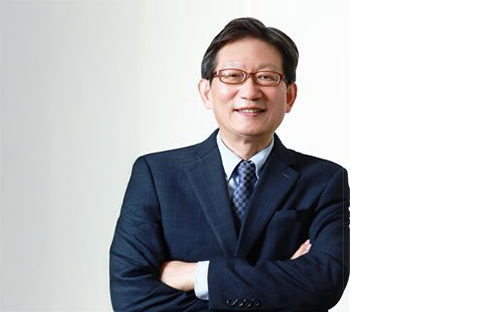
Prof. Oh Tae-seok, selected as 50 Excellent Performance for Academic Research Support Projects by the Ministry of Education The third award since 2012 and 2015 Prof. Oh Tae-seok of the Dept. of Chinese Language and Literature at Dongguk University was awarded the excellent performance for academic research support project by the Ministry of Education on last 17th (Thu).The annual “Award Ceremony of the excellent performance for academic research support project”, organized by the Ministry of Education, has been conducted to inspire the researchers' passion for research and encourage continuous R&D by discovering outstanding practices of academic and research support projects.In his thesis "Meta-scientific Interpretation of Traditional East-Asian Space-time Perspective in Comparison with Contemporary Physics", Prof. Oh reinterpreted the characteristics of East Asian space-time representations such as the book of change, Laozi and Zhuangzi, and Buddhism from the perspective of humanities-based convergence, by citing the achievements of modern physics such as the theory of relativity and quantum mechanics. This study is the achievement of second year of a mid-level research project supported by the National Research Foundation of Korea.In particular, Prof. Oh has accumulated high-quality research achievements, which was selected as the third excellent performance in the academic research support project of the Ministry of Education since 2012 (the Book of Change) and 2015 (Laozi).
2020.12.17. 2865 -
Professor Jongpil Kim selected as “Scientist of the Month” by th...
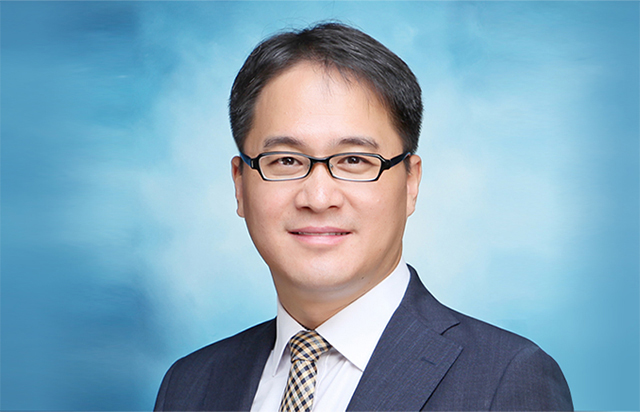
Professor Jongpil Kim selected as “Scientist of the Month” by the Ministry of Science and ICT Contributing to the development of innovative technology in cell therapy for neurodegenerative diseases Jongpil Kim, professor of chemistry at Dongguk University, has been selected as “Scientist of the Month” for December by the Ministry of Science and ICT and the National Research Foundation of Korea.Kim developed the first innovative nanobiotechnology in the world and completed in vivo neuronal reprogramming technology, thereby setting a milestone for the treatment of neurodegenerative diseases like Parkinson’s disease. Details of this accomplishment are published in Nature Nanotechnology (IF 31.5, 2017).The article was published with Kim and a Dongguk University PhD student as the sole corresponding author and first author. It is acclaimed for having taken global research competencies in Korean regenerative medicine and advanced biomedical technology to the next level.“This research has great academic value in that it provides a globally original technology for treating cranial nerve disorders based on in vivo reprogramming, which is the next generation in stem-cell technology,” said Kim. “Above all, commercializing this research achievement will have a considerable economic and social ripple effect throughout the field of regenerative therapy for neurodegenerative diseases.”
2020.12.09. 2796 -
Dept. of E.L.I.T. of Dongguk University Selected for the BK21 FO...
Dept. of E.L.I.T. of Dongguk University Selected for the BK21 FOUR Project as a 'Team for Training Future Professionals for Interpretation & Translation (Studies) in the Areas of Cognitive Science and AI Based on the Industry-University Cooperation Business Model' The Department of E.L.I.T. has been selected for the BK21 FOUR Project supervised by the Ministry of Education. The project team is officially known as the 'Team for Training Future Professionals for Interpretation & Translation (Studies) in the Areas of Cognitive Science and AI Based on the Industry-University Cooperation Business Model'. The BK21 FOUR project improves the educational and research competencies of outstanding graduate schools and nurtures specialists with master's or doctoral degrees with the aim of boosting the future competitiveness of the country. BK21 FOUR will span seven years (Sep. 1, 2020 to Aug. 31, 2027), and has a budget of up to 1.55 billion won. The research team manager is Prof. Park Myeong-gwan, with Prof. Kim Soon-yeong, Prof. Park Beom-sik, Prof. Shin Jeong-ah, and Prof. Hong Jeong-min as its members. The education research team aims to train interpretation and translation professionals in cognitive science and AI, which are gaining in importance as the world steps into the 4th Industrial Revolution. It will nurture specialists in advanced English and language services, in creating data for realizing AI-based interpretation and translation, and in analyzing language resources, among others. In particular, the project will create an industry-university business model, thereby increasing job opportunities and upgrading the professionalism and practicality involved in research. Prof. Park Myeong-gwan said, "To accomplish these goals, we will expand our cooperation with academics and businesses operating in cognitive science and AI, and actively publish research results."
2020.11.13. 2450 -
Hangzhou Normal University, Harvard University, Dongguk Universi...
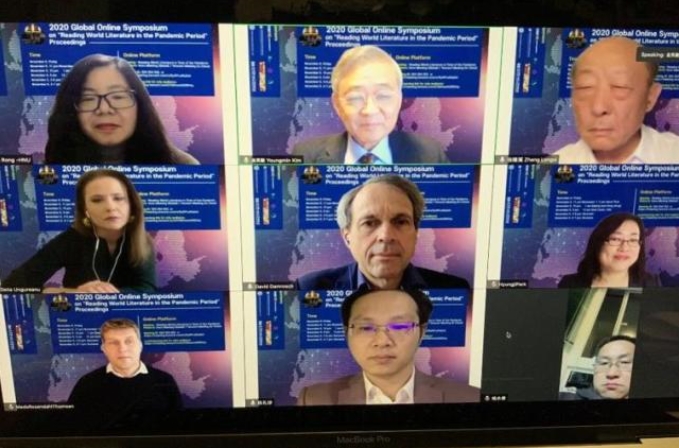
Hangzhou Normal University, Harvard University, Dongguk University and other universities jointly organize the World Literature International Cloud ForumThe 2020 World is co-sponsored by the School of Foreign Languages, Hangzhou Normal University, the Institute of World Literature, Harvard University, Dongguk University, Korea National Research Foundation Global Research Network (NRF-GRN), and the Comparative Literature and Intercultural Research Society of the Chinese Society of Foreign Literature The Literary International Cloud Forum was successfully held on November 6-7, Beijing time.In the context of the global spread of the new crown epidemic, the theme of this forum is "Reading World Literature in the Era of the Epidemic", and the organizers will be held in collaboration through online venues. Professor Zhang Longxi, City University of Hong Kong, Chairman of the International Society for Comparative Literature, Professor David Damrosch, Director of the Institute of World Literature, Harvard University, Professor Ou Rong, Dean of the School of Foreign Languages, Hangzhou Normal University, Professor Thomson, Aarhus University, Denmark (Mads Thomsen), Deputy Director of the Institute of World Literature, Harvard University, Associate Professor Delia Ungureanu (Delia Ungureanu), University of Bucharest, Romania, Professor Chen Lizhen, Associate Dean of Hangzhou Normal University Research Institute, and Professor Youngmin Kim of Dongguk University and Jack Ma Chair Professor of Hangzhou Normal University. More than 300 experts and scholars at home and abroad, including Professor Youngmin Kim and Professor Hyungji Park of Yonsei University in South Korea, gathered in the cloud to exchange ideas and enlighten wisdom.Professor Kim Youngmin presided over the opening ceremony, and Professor Damrosh and Professor Ou Rong delivered opening speeches in turn. Professor Chen Lizhen presided over the first half of the forum.In the first half of the forum speech, Professor Damroche first expressed his views on the topic of "Reading in the Epidemic in Two Rooms". Professor Damroche pointed out that the new crown pneumonia epidemic has forced us to pay more attention to works describing the plague when reading, and try to get enlightenment from these works to deal with the current situation. Professor Damroche listed and analyzed works such as Boccaccio’s Decameron, Tagore’s “Home and the World”, Marquez’s “A Hundred Years of Solitude” and Saul Bellow’s “Rain King Henderson”, To point out the various issues that the writers are discussing behind the text of the work.Professor Wengulianu dialectically viewed the phenomenon of people being lonely due to the epidemic being forced to stay at home, and innovatively affirmed the "value of loneliness". From Marc Aurelius to Montaigne, from Woolf to the feminist Enola Holmes (Enola reversed as Alone), Professor Ungureanu tells the story of loneliness participating and interfering in world history repeatedly.Professor Park Hyungji was inspired by the Harvard University political philosopher Michael Sandel’s cloud debate on “When and How to Reopen America” in April 2020 and proposed “Ethics of the Epidemic and End-Time Literature”. Professor Park analyzed the "Ghost Ghostwriting" (1999) by British writer David Mitchell and the novel "Vegetarian" (2007) by Korean female writer Han Jiang, revealing the ethics and society related to the current epidemic period in the novel problem.Professor Kim Youngmin talked about the "Poetic Self in World Literature". Using the scale as a metaphor, Professor Jin tried to connect the scale of aesthetic distance with the lyrical word "I" in modern and contemporary poetry during the epidemic period. At the end of the first half of the forum was an active question and answer session. The opinions of teachers, students and scholars from all over the world and the four experts sparked a spark of thought. They actively put forward their own ideas and questions, and addressed their problems. The experts gave detailed answers one by one.The second half of the forum was hosted by Professor Damrosh. First, Professor Zhang Longxi gave a keynote speech on "Epidemic, Maintaining Social Distance, Literary Reading and Writing". Professor Zhang Longxi believes that the struggle between viruses and humans has always existed. The current COVID-19 epidemic has stimulated literary imagination and creativity just like the plagues of the past, just like Boccaccio’s Decameron and Daniel Defoe’s Plague Year Magazine and Poe’s "Mask of the Red Death" and other works about the plague were shown. Therefore, in this new crown pneumonia epidemic, literature has once again proved to be the best way to express our indomitable spirit in the face of global challenges, heroism in difficult times, our love for humanity and the nobility of human dignity. Professor Zhang also On the spot, he recites his own poem about the epidemic.Professor Thomson emphasized the human community in his speech entitled "Going Against: Nationalism and Universalism Growing in the Epidemic" and explored some historical uses of global issues in literature and how they play a special role in world literature .Finally, Professor Ou Rong discussed "Viral Poetics and Epidemic Poetry: Rethinking World Literature in an Epidemic Era". Professor Ou Rong made a rough review of Chinese and English poems in response to the new crown pneumonia epidemic around the world, and selected some poems for promotion and interpretation, and proposed to rethink world literature from the perspective of "viral poetics": just like the epidemic of the virus, ignore it The boundaries of race, skin color, language, and national borders should not set artificial barriers to the study of world literature. Any literary work, which is not only native literature, but also through the Internet and various translation tools, has also become undiscovered. World literature.The World Literature International Cloud Forum has aroused great repercussions in the international academic community. Many foreign media have carried out vigorous publicity reports, such as e-대학저널, Pinpoint News, Metro News, The Public, Veritas, 스마트경제, 브릿지 and other media releases related news. The forum is strongly affirmed by the international academic community, and the importance and significance of reading world literature during the epidemic is self-evident. The successful holding of this international academic exchange activity provides an important platform for communication between domestic academic circles and internationally renowned scholars, and opens up broad prospects for the development of comparative literature and cross-cultural studies.
2020.11.10. 2854 -
Research team of Professor Sung-in Cho at Dongguk University dev...
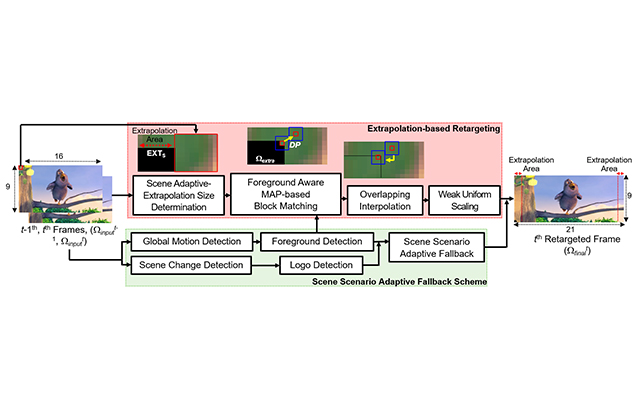
Research team of Professor Sung-in Cho at Dongguk University develops video aspect ratio adjustment technology using video extrapolation A research team led by Multimedia Engineering Professor Sung-in Cho at Dongguk University has developed innovative technology for adjusting the aspect ratio of video contents using video area expansion. The multimedia engineering technology was published in IEEE Transactions on Image Processing (Impact Factor: 9.340, top 3.947% JCR), the most prestigious journal in the field of image processing. The research led by Professor Cho significantly improved user satisfaction by expressing the aspect ratio of a video content display without distortion. It was necessary for the research team to ensure that the aspect ratio adjustment algorithm could be used in actual display products. They successfully verified their work, by proposing a method that creates a region that does not exist in the input image, and an algorithm that can block visual distortion that users can feel in advance. Summarizing his work, Professor Cho stated the following: "This research has developed a new approach that can express existing content without distortion in the recently diversified display aspect ratios”. He added that “Through an experiment, we verified that the algorithm proposed by displays with various aspect ratios shows overwhelmingly outstanding customer satisfaction to the existing aspect ratio adjustment technology”. This research was conducted in collaboration with Sogang University and was supported by Samsung Electronics, alongside the National Research Foundation of Korea.
2020.10.28. 2492

- Seoul Campus
- 30, Pildong-ro 1-gil, Jung-gu, Seoul, 04620, Republic of Korea
- Tel. +82-2-2260-3314 Fax. +82-2-2260-2277
- incoming@dongguk.eduExchange Program
- scf@dongguk.eduInternational Students Services
- adm@dongguk.eduInternational admission
- cscenter@dongguk.eduCertificate Issuance, Education Verification
- kic@dongguk.eduKorean Language Course
Copyright(c) DONGGUK UNIVERSITY. ALL RIGHTS RESERVED.